ACEA A/B: one class, three different purposes
ACEA A3/B4, A5/B5 and A7/B7 are European performance sequences for passenger-car and light-duty-van engine oils. The A side relates principally to gasoline-engine service, while B relates to light-duty diesel applications. They are grouped as ACEA’s “high SAPS” A/B class: SAPS means sulphated ash, phosphorus and sulphur, additive-related properties that can matter to exhaust-aftertreatment durability.
The slash does not mean an oil is a blend of two grades. It is one combined sequence. Neither does the number create a universal ranking. A7/B7 includes extra protection requirements relevant to certain modern direct-injection engines, but that does not make it an automatic substitute for every A5/B5 or A3/B4 application. Oil choice must begin with the exact requirement, SAE viscosity grade and service instructions in the current vehicle documentation.
For the wider framework, see the site’s overview of ACEA engine-oil sequences. ACEA sequences set defined baseline performance categories; they are not the same thing as a vehicle manufacturer’s own approval.
The practical distinction: HTHS viscosity
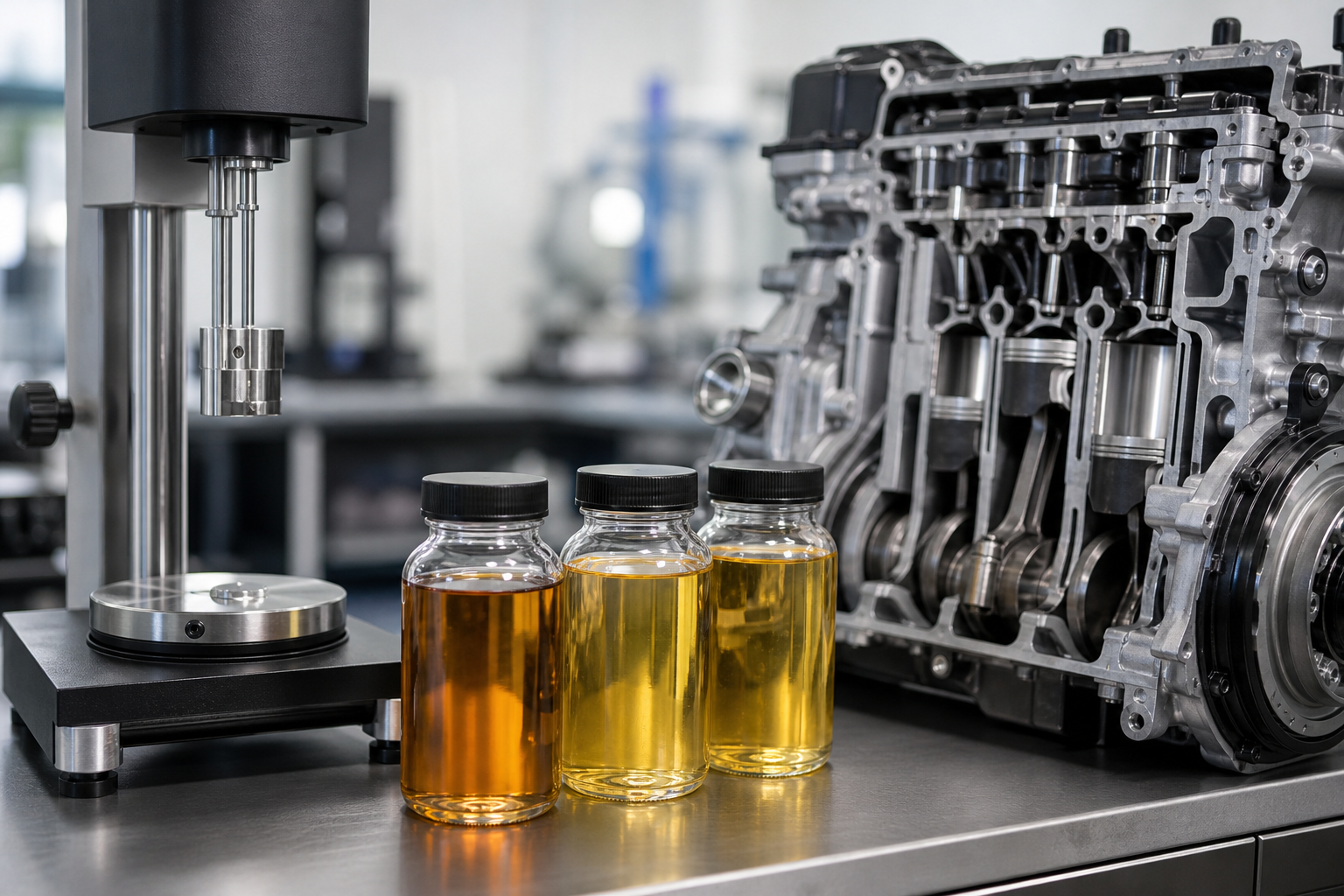
The main technical divider is high-temperature, high-shear (HTHS) viscosity. This is a laboratory measure of how resistant an oil is to flow at 150°C while subjected to intense shearing. It is intended to represent demanding lubricated contacts, such as bearings, more closely than the familiar SAE viscosity label alone.
| Sequence | HTHS viscosity requirement | General intent |
|---|---|---|
| ACEA A3/B4 | At least 3.5 mPa·s | Higher-HTHS oil for specified gasoline and light-duty diesel engines, including applications with manufacturer-specified extended drains. |
| ACEA A5/B5 | 2.9 to 3.5 mPa·s | Lower-HTHS, fuel-economy-oriented oil for engines specifically designed for it. |
| ACEA A7/B7 | 2.9 to 3.5 mPa·s | Lower-HTHS oil with additional protection requirements for certain turbocharged gasoline direct-injection and modern direct-injection diesel engines. |
In plain English, an A3/B4 oil retains a higher minimum viscosity under severe hot, high-shear conditions than an A5/B5 or A7/B7 oil. That can be fundamental to an engine’s design. It is therefore unsafe to replace a required A3/B4 oil with an A5/B5 or A7/B7 product simply because the latter sounds newer or promises better fuel economy.
The reverse assumption is also wrong. An A3/B4 oil is not automatically an acceptable replacement when an engine calls for A5/B5 or A7/B7. A higher HTHS value does not reproduce the lower-viscosity friction behavior, fuel-economy performance and other calibrated properties anticipated by an engine designed around one of those sequences. The SAE grade on the bottle is also not enough: two oils marked 5W-30 can have different HTHS viscosity and different ACEA claims. Read what oil viscosity means for the distinction between an SAE grade and measured viscosity.
What makes A7/B7 different from A5/B5?
A7/B7 occupies the same broad HTHS band as A5/B5, but it adds tests and limits aimed at newer engine risks. ACEA identifies added protection against low-speed pre-ignition (LSPI) and wear in turbocharged gasoline direct-injection engines, plus turbocharger-compressor-deposit protection for modern direct-injection diesels.
LSPI is an abnormal combustion event that can occur at low engine speed and high load in some small turbocharged gasoline engines. It is not ordinary spark knock, and it can be severe. The article on LSPI and how oil helps control it explains the issue in more detail.
Those additional requirements are valuable where an OEM specifies A7/B7, but they do not turn A7/B7 into a general “A5/B5 Plus” replacement. ACEA categories combine a set of tests, limits and intended applications. An OEM may require a particular sequence alongside its own approval, a particular volatility limit, an exact SAE grade, or other properties outside the sequence. It may also specify an ACEA C-category low- or mid-SAPS oil instead; those oils are addressed separately in the guide to ACEA C categories.
Do not treat “high SAPS” as a fitment instruction
“High SAPS” is a comparison within the ACEA classification system, not a universal instruction to use A/B oil in every vehicle without a particulate filter. A/B oils have different additive limits and aftertreatment implications from ACEA C oils, but fitment is determined by the vehicle maker’s stated requirement. Modern gasoline engines can have gasoline particulate filters, and light-duty diesels can have diesel particulate filters and other emissions hardware. The correct sequence is the one specified for the particular engine and market.
Also, B does not mean heavy-duty truck diesel. ACEA’s A/B class covers passenger-car and light-duty diesel service. Heavy-duty diesel oils are classified in ACEA’s E categories or by other relevant industry and engine-manufacturer requirements.
How to read the year suffix
You may see a claim such as ACEA A3/B4-23, A5/B5-23 or A7/B7-23. The suffix identifies the ACEA sequence issue or performance severity level used for the claim; it is not the oil’s manufacturing date and not a vehicle model-year recommendation. ACEA revises its sequences as test methods and engine needs evolve. For a category retained across issues, a newer severity issue is intended to maintain the applications of the earlier issue; if that were not possible, ACEA’s process calls for a new category.
That principle still does not override an OEM requirement. A label that merely says “meets ACEA A7/B7” should be evaluated as an ACEA performance claim, while an OEM approval is a separate matter. See how to distinguish licensed, approved and suitable-for claims.
A sensible selection checklist
Find the exact engine-oil requirement in the current owner’s manual, service information or official lubricant list.
Match the specified SAE grade first; do not infer suitability from the word “synthetic” or from another oil’s grade.
Match the required ACEA category and issue where the manufacturer states one.
Check for a required OEM approval or material specification in addition to ACEA.
Use the manufacturer’s oil-life system or stated drain interval; an ACEA extended-drain description does not authorize a longer interval by itself.
The useful shortcut is this: A3/B4 is the higher-HTHS A/B route; A5/B5 is the lower-HTHS fuel-economy route; and A7/B7 is the lower-HTHS route with added modern direct-injection protections. The correct route is not the newest-looking label—it is the one your engine manufacturer specifies.