Why the wording on an oil label matters
Two bottles can share the same SAE viscosity grade, such as 0W-20 or 5W-30, and both may be described as full synthetic. That does not establish that they are interchangeable. Viscosity describes how the oil flows under specified conditions; it does not, by itself, confirm engine-test performance, emissions-system compatibility, fuel-economy characteristics or vehicle-manufacturer acceptance.
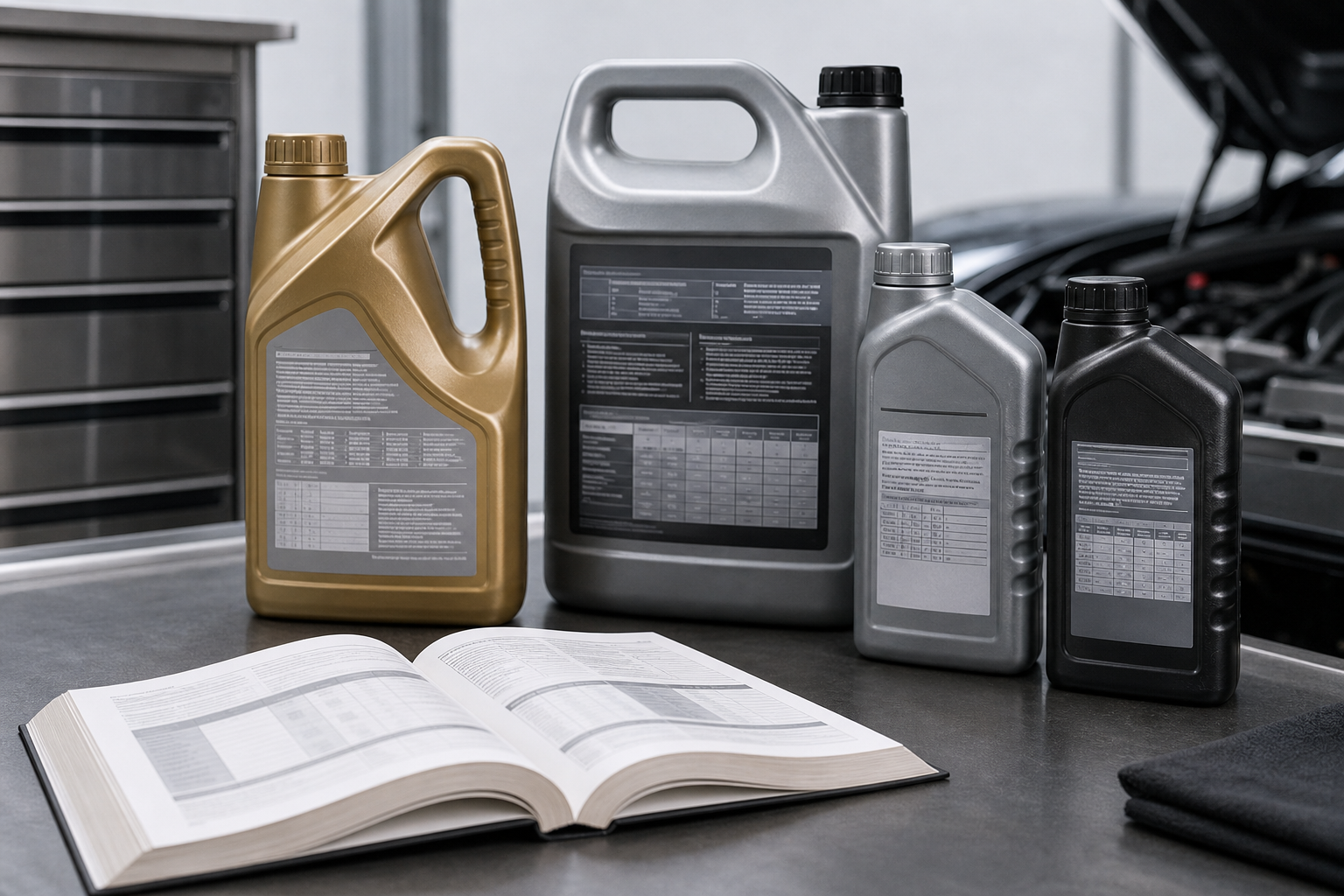
The important wording is usually found on the back label and the product technical data sheet. Terms such as API licensed, ACEA claim, approved, meets and recommended for represent different kinds of statements. Reading them correctly helps avoid treating a broad industry category as if it were an exact vehicle approval.
Start with the vehicle requirement
The owner’s manual, service information or manufacturer’s current lubricant lookup is the starting point. Record the complete requirement, not just one familiar part of it. A proper requirement may include:
an SAE viscosity grade, such as 0W-20;
an API or ILSAC category, such as API SQ or ILSAC GF-7A;
an ACEA sequence, such as C5 or C6; and
a manufacturer specification or approval, such as dexos1 Gen 3, MB 229.52 or VW 508 00.
These are layers, not synonyms. The vehicle maker may require several of them at once. For example, an oil can have the right viscosity and a current API category but still lack the manufacturer approval specified for the engine. For a closer explanation of the distinction, see why an ACEA sequence is not a vehicle approval.
What “API licensed” means
API’s Engine Oil Licensing and Certification System is a voluntary licensing program. A marketer may use the API Donut and, where applicable, the Starburst or Shield only for a product that is licensed for the stated viscosity grade and service category. API maintains a licensee directory and operates monitoring and enforcement procedures.
This makes an API mark useful evidence that a specific packaged oil participates in that program. It is not a universal declaration that the oil fits every engine. API itself notes that its licensing does not mean an oil is appropriate for all engines in service. An engine requiring a manufacturer-specific oil can therefore demand more than the current API category alone. See API SQ and ILSAC GF-7 explained for the current gasoline-oil categories and marks.
What an OEM approval or license means
A formal vehicle-manufacturer approval, authorization or license is a stronger and more specific claim when the manufacturer operates such a program. The terminology and evidence differ by brand. GM dexos products, for example, carry a dexos icon and license number and can be checked against GM’s licensed-product information. Mercedes-Benz publishes product lists under individual operating-fluid sheets, while its manuals direct owners to identify products by the relevant MB-Approval wording.
In practical terms, a formal approval normally means the oil has been accepted into that manufacturer’s program for the named specification. It does not mean every oil from the same brand, or every viscosity within the same product family, shares that status. Approval can be specific to a product name, formulation and viscosity grade.
| Label wording | What it generally indicates | What to verify |
|---|---|---|
| “API licensed” with API mark | Participation in API’s licensing system for the stated product and category. | Correct API category, viscosity grade and current directory entry. |
| “Approved,” “licensed” or an OEM approval number | A claim of formal recognition under a manufacturer program. | The exact approval wording and, where available, the OEM’s current product list. |
| “Meets” or “meets the requirements of” | The oil marketer states that its product satisfies a named requirement. | Exact wording on the technical data sheet; do not assume it is an OEM approval. |
| “Recommended for” or “suitable for” | A compatibility recommendation from the oil marketer. | Whether the manual actually permits that specification and whether a formal approval is required. |
Why ACEA wording requires care
ACEA sequences are valuable performance classifications, especially for European vehicles, but ACEA does not license or certify finished oils. Oil manufacturers are responsible for substantiating their ACEA claims. That does not make an ACEA claim meaningless; it means the claim is not the same type of third-party or OEM licensing statement as an API license or a manufacturer approval program.
An oil labeled ACEA C3, for instance, may be appropriate where the vehicle manual calls for C3 alone. It cannot automatically be assumed to carry every manufacturer approval that happens to use C3-related performance requirements. The manufacturer code remains decisive whenever one is specified.
A reliable selection process
Find the exact engine-oil requirement in current manufacturer documentation for the vehicle and engine.
Match the required viscosity grade as well as the specification or approval.
Read the bottle and the current technical data sheet for the exact product name.
Where a formal program exists, check the manufacturer’s or licensing body’s current directory.
Do not substitute a broad phrase such as “European formula,” “full synthetic” or “for modern engines” for the required specification.
Oil labels are concise by necessity, while compatibility decisions are not. Treat an API category, an ACEA sequence and an OEM approval as separate pieces of technical information. The safest choice is the oil that matches the complete current requirement for the vehicle—not merely the bottle with the most impressive-looking list of claims.