API GL labels describe a service category, not a complete fluid specification
API GL-4 and API GL-5 are familiar markings on gear-oil bottles, but they are easy to oversimplify. They do not identify a viscosity grade, a vehicle approval, or a guarantee that one product is interchangeable with another. They are automotive gear-lubricant service designations: broad descriptions of the operating conditions and gear designs for which a lubricant was intended.
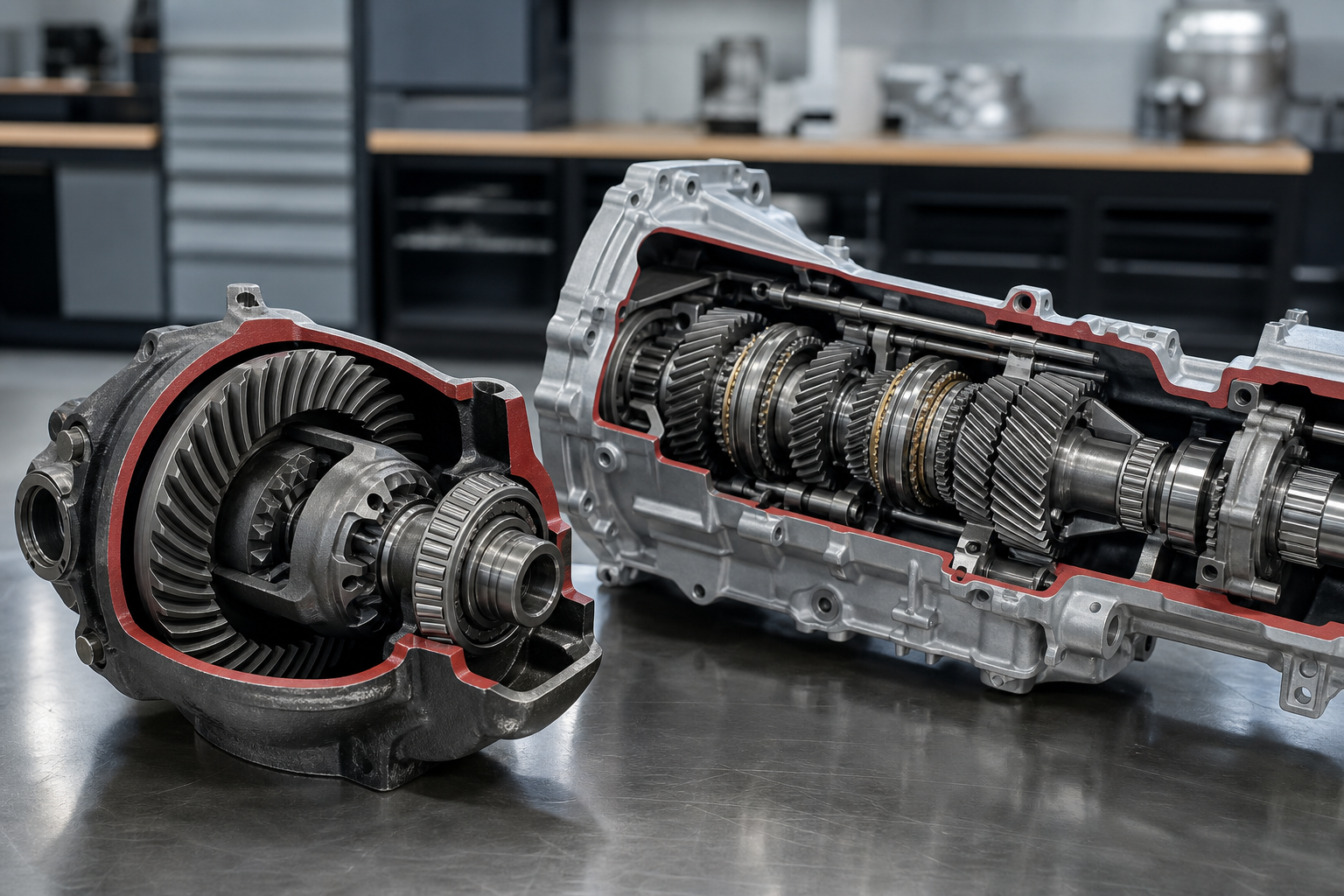
The distinction matters because a modern vehicle may have a manual transmission, transfer case, front differential, rear differential, limited-slip differential, or transaxle. Those units can have very different friction, wear, seal-compatibility, and temperature-control needs. A bottle marked GL-4 or GL-5 supplies only part of the selection information. The owner’s manual, factory service information, or current manufacturer lubricant specification remains the deciding document.
What API GL-5 means
API GL-5 is the API automotive gear-lubricant designation still listed as being in current use in API 1560, the API document covering manual-transmission, transaxle, and axle lubricant designations. It is aimed particularly at heavily loaded hypoid gears in axles.
A hypoid gear set is common in many drive axles and differentials. Its pinion gear is offset from the ring gear centerline, which creates substantial sliding contact in addition to rolling contact. That geometry helps packaging and durability, but it also places high demands on the lubricant under high-speed shock loading and low-speed, high-torque operation. GL-5 therefore addresses a demanding axle application, rather than serving as a universal “better gear oil” label.
ASTM D7450 provides the performance test framework for oils intended to meet API GL-5 service. SAE J2360 is another important gear-lubricant standard: API notes that a lubricant approved to SAE J2360 satisfies GL-5 requirements, while J2360 adds requirements beyond GL-5, including items such as elastomer compatibility and post-oxidation gear cleanliness.
Why GL-4 is more complicated today
Historically, API GL-4 described lubricants for spiral-bevel axles under moderate to severe service and for hypoid axles under moderate conditions. It was also used for selected manual transmissions and transaxles when a different heavy-duty transmission lubricant was unsuitable. That legacy explains why GL-4 remains common on retail products and appears in service literature for many older vehicles.
However, API’s ninth edition of API 1560, published in November 2023, moved GL-4 into the group of service designations not in current use. API explains that the associated performance-verification test equipment is no longer available. The document specifically advises users seeking a GL-4 lubricant to request appropriate supporting documentation from the supplier for products previously tested.
This does not mean every product carrying a GL-4 claim is automatically unsuitable, nor does it erase a vehicle manufacturer’s GL-4 requirement. It means the label should be interpreted carefully. A current product may use GL-4 as a legacy service claim, but the claim alone cannot communicate all of the performance characteristics needed by a particular synchronized gearbox or transaxle.
GL-5 is not automatically a substitute for GL-4
The common assumption is that GL-5 must replace GL-4 because the number is higher. API does not present the categories as a universal progression for every component. Instead, the descriptions focus on different service conditions. GL-5 is associated with highly loaded, sliding-contact axle gears, while GL-4 was used in certain manual-transmission and transaxle applications as well as axle applications.
Manual transmissions with synchronizers are a key reason to avoid guesswork. Synchronizers rely on controlled friction to match gear and shaft speeds during a shift. A transmission fluid must deliver the friction behavior, viscosity, protection, and material compatibility required by that specific design. An axle oil that is excellent in a hypoid differential may not meet all the requirements of a synchronized manual gearbox, even if its viscosity looks similar.
Likewise, a limited-slip differential may need an additional friction characteristic specified by the axle manufacturer. API 1560 notes that limited-slip requirements are normally defined by the manufacturer, not by the base GL designation. Do not assume that every GL-5 product includes the correct limited-slip friction modifier, or that an additive supplement is appropriate, unless the vehicle documentation says so.
Viscosity is a separate decision
SAE gear-oil viscosity grades and API GL service designations answer different questions. A grade such as SAE 75W-90 describes viscosity behavior; GL-5 describes a service-performance category. Matching one does not automatically match the other. Two SAE 75W-90 products can have different friction properties, manufacturer approvals, and intended applications.
Also, gear-oil viscosity numbers must not be compared directly with engine-oil grades. The SAE system for automotive gear lubricants is separate from the system used for engine oils. A 75W-90 gear oil is not comparable in thickness to a 75W-90 engine oil.
A practical selection checklist
Identify the exact component being serviced: transmission, transaxle, transfer case, front axle, rear axle, or differential.
Use the viscosity grade and fluid specification stated in the current vehicle manufacturer documentation.
Look for an explicit manufacturer approval or documented claim when the manual calls for a proprietary fluid specification.
Treat GL-4 and GL-5 as supporting information, not as a substitute for the complete requirement.
For limited-slip units, confirm whether the specified fluid must include limited-slip friction performance.
Do not fill automatic, dual-clutch, continuously variable, or automated manual transmissions with ordinary gear oil unless the manufacturer expressly specifies it.
The bottom line
API GL-5 remains a current service designation for severe hypoid-axle duty. GL-4 remains a meaningful legacy description, but API no longer classifies it as current because the original verification hardware is unavailable. Neither label is a blanket approval for every gearbox or axle. Match the complete manufacturer requirement before choosing a gear lubricant.