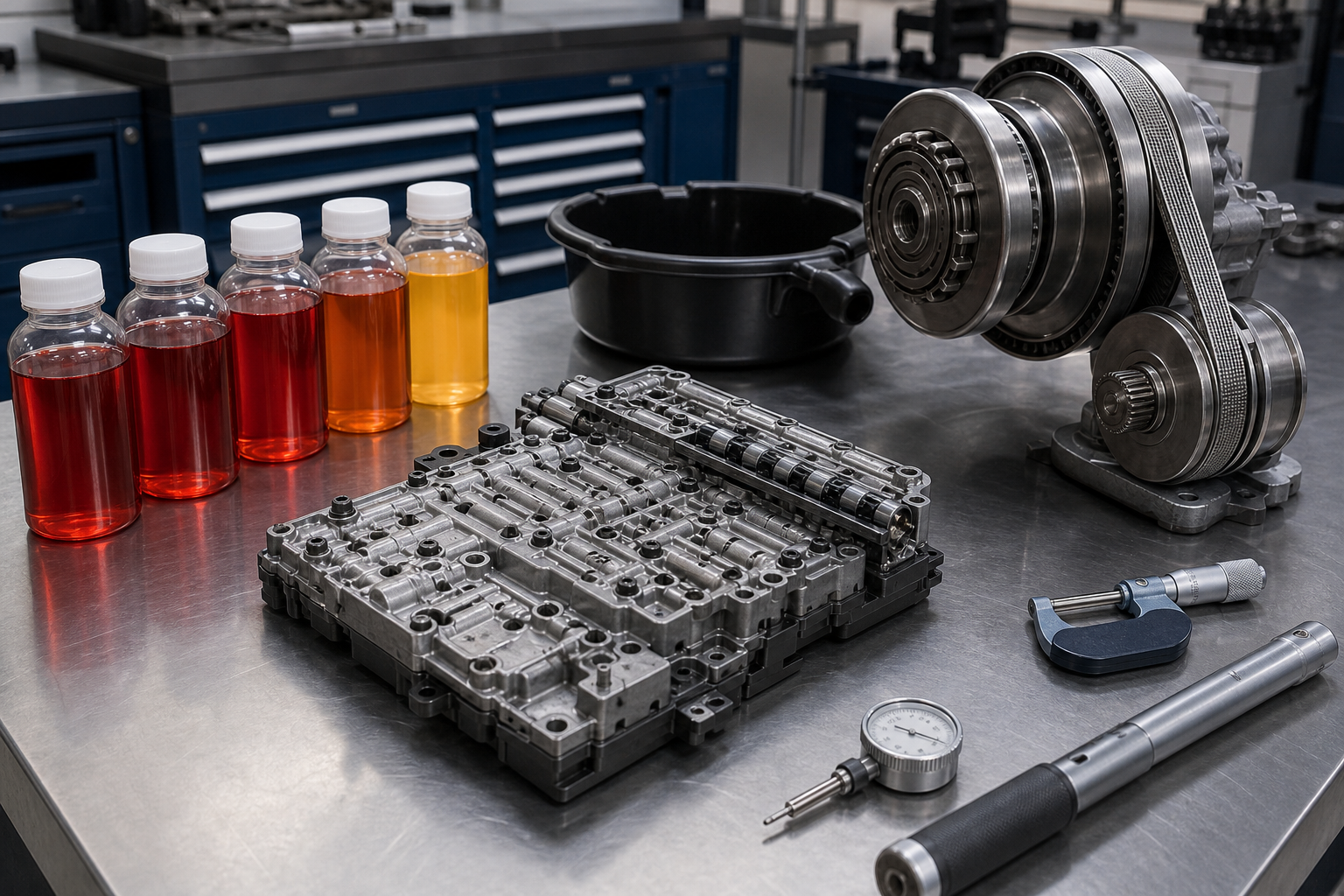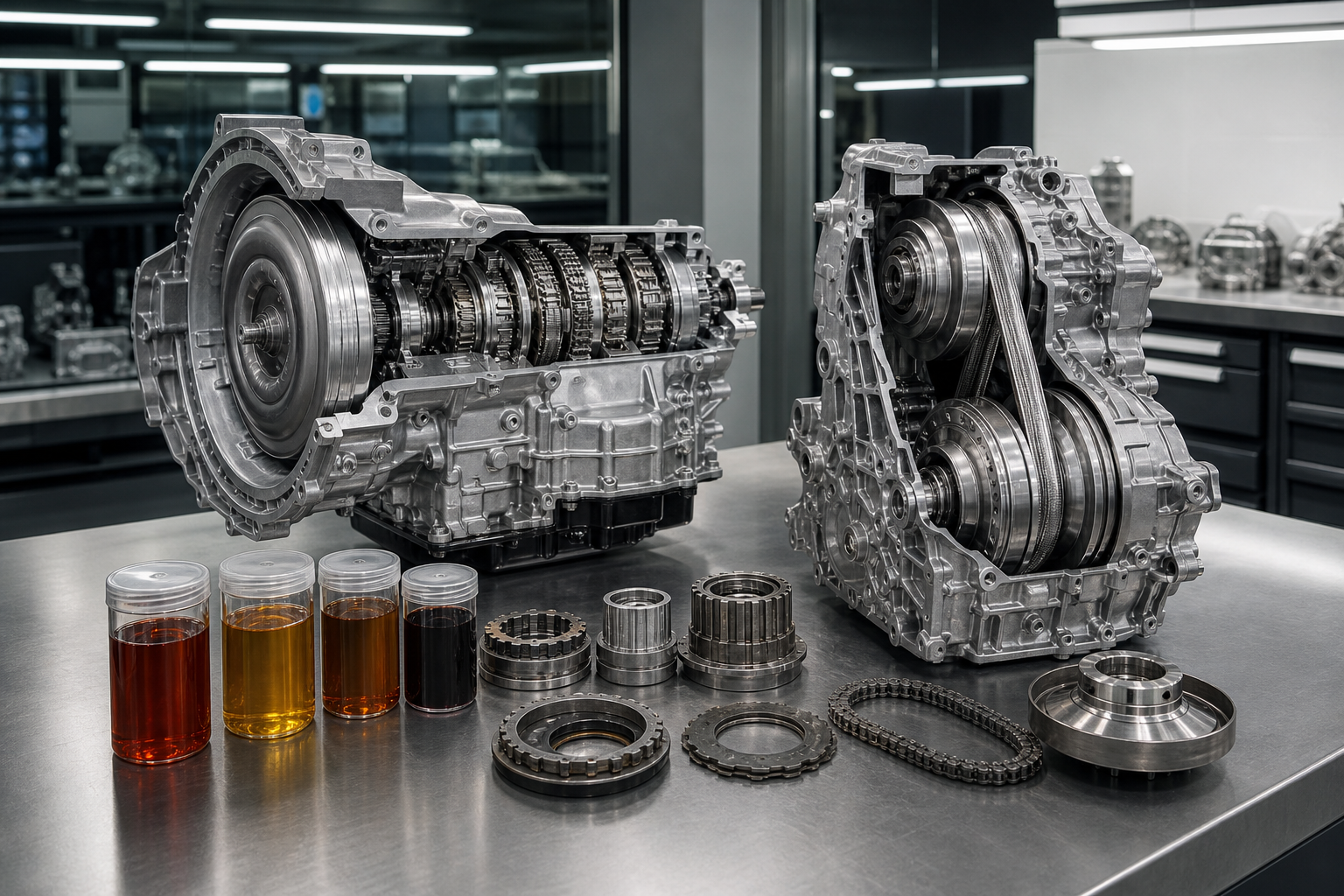
Hyundai and Kia automatic-transmission-fluid labels can look deceptively similar. A bottle marked SP-III, SP-IV, SP-IV-RR or SP4-M may be red ATF, but that does not make it a universal replacement for the others. These are manufacturer fluid requirements tied to particular transmission families, calibration, clutch materials and service procedures.
The practical rule is simple: use the exact ATF specification stated for the vehicle’s transmission. Do not select fluid by brand, color, gear count or a belief that the highest-looking number must be better. The owner’s manual and the current service information for the VIN remain the deciding documents.
What the SP labels mean
“SP” is Hyundai Motor Group terminology for several automatic-transmission-fluid formulations. It is not an SAE viscosity grade, an API service category or a universal industry standard such as a broadly licensed DEXRON fluid. A product must match the particular Hyundai or Kia fluid requirement—not merely be described as suitable for Asian vehicles.
| Fluid designation | Practical context | Do not assume |
|---|---|---|
| SP-III | Older Hyundai and Kia conventional automatic transmissions | That it can replace SP-IV in a newer transmission |
| SP-IV | Many later conventional automatic transmissions, including numerous six-speed applications | That every Hyundai or Kia automatic requiring an SP fluid uses SP-IV |
| SP-IV-RR | Specific rear-wheel-drive eight-speed applications | That “RR” is just a packaging or regional suffix |
| SP4-M or SP4M-1 | Specified newer conventional automatic-transmission applications | That it is interchangeable with SP-IV because the names are similar |
SP-III: an older requirement, not a generic fallback
SP-III appears in older Hyundai and Kia automatic-transmission applications. Its continued appearance in service information does not mean that it is obsolete for every vehicle that once specified it; it means the transmission was engineered and validated around that fluid behavior.
However, SP-III should not be treated as a low-cost substitute for later SP-IV or SP4-M requirements. Automatic transmissions depend on closely managed friction characteristics: the controlled grip between clutch plates during engagement. A fluid with the wrong friction profile can contribute to poor shift timing, shudder, flare, harsh shifts or accelerated clutch distress. Viscosity is only one part of the equation.
SP-IV: common, but still application-specific
SP-IV is widely encountered in Hyundai and Kia vehicles equipped with conventional automatic transmissions. That familiarity can create a false impression that it is the group’s default ATF. It is not. Current Hyundai owner documentation still identifies SP-IV for certain automatic-transmission applications, while other models specify different fluids.
A replacement product should state clearly that it meets the required SP-IV specification. Be careful with vague wording such as “compatible with,” “recommended for” or “for use in most Asian vehicles.” Such language may be useful background, but it is not equivalent to confirming the exact service requirement. For a broader explanation of this labeling issue, see why universal ATF needs verification.
SP-IV-RR: a distinct fluid for specified eight-speed units
The “RR” suffix matters. Hyundai service information for certain rear-wheel-drive eight-speed vehicles explicitly requires SP-IV-RR and warns against using SP-III or ordinary SP-IV in its place. In other words, the manufacturer itself does not treat SP-IV-RR as an automatic upgrade from SP-IV, or as an alternative name for it.
This distinction is especially important when a vehicle has an eight-speed automatic. Eight speeds alone do not identify the fluid: different transmissions within the Hyundai, Kia and Genesis range may have different layouts, suppliers and requirements. A workshop should verify the transmission code and the vehicle-specific service procedure rather than ordering fluid from the number of forward gears.
SP4-M and SP4M-1: similar name, separate requirement
SP4-M and SP4M-1 appear in newer Hyundai and Kia documentation for specified automatic-transmission applications. The formatting varies—some documents use a hyphen and others do not—but the important point is the complete designation stated by the manufacturer.
Do not collapse SP4M-1 into SP-IV. Hyundai and Kia manuals can list both SP-IV and SP4M-1 across different vehicles, demonstrating that the specification follows the transmission application. In addition, a hybrid, battery-electric or dual-clutch model may use a different transmission, reduction gear or control-oil requirement altogether. A conventional ATF may be wrong even if the vehicle has a selector marked P, R, N and D.
Why the fluid level procedure matters too
Correct fluid selection is only half of a proper service. Many modern transmissions do not have a dipstick and use an overflow or level-check plug. Their fluid level must be set with the vehicle level, engine state and ATF temperature within a specified range. Filling by the amount drained can be inaccurate if the previous level was wrong or if fluid remains in passages, a cooler or a torque converter.
This is one reason not to treat every transmission service as a simple drain-and-refill job. Follow the manual’s temperature, scan-tool and fill-level instructions. Also use the maintenance interval and operating conditions published for the exact vehicle; towing, repeated short trips, heavy traffic and commercial use can change the service schedule.
How to verify the correct Hyundai or Kia ATF
Identify the exact year, model, engine, drivetrain and transmission—not just the vehicle badge.
Check the owner’s manual first, then current manufacturer service information for the VIN when available.
Match the complete fluid name, including suffixes such as RR or M-1.
Confirm that an aftermarket product makes a specific, documented claim for that requirement.
Use the specified level-setting procedure and temperature range.
Keep the invoice and product label as part of the vehicle’s service record.
SP-III, SP-IV, SP-IV-RR and SP4M-1 are not a family of freely interchangeable fluids. The transmission determines the specification, and the specification determines the fluid. When documentation conflicts or the vehicle has had a transmission replacement, verify the installed unit before filling it.