These names identify transmission requirements, not a universal fluid family
Nissan Matic S, Nissan CVT Fluid NS-2 and Nissan CVT Fluid NS-3 are easy to confuse because all are transmission lubricants carrying Nissan names. They are not, however, interchangeable grades or a simple oldest-to-newest progression. The first question is not which fluid appears newer, thinner or more widely stocked. It is which transmission is fitted to the specific vehicle, followed by the fluid requirement in its current owner’s manual or service information.
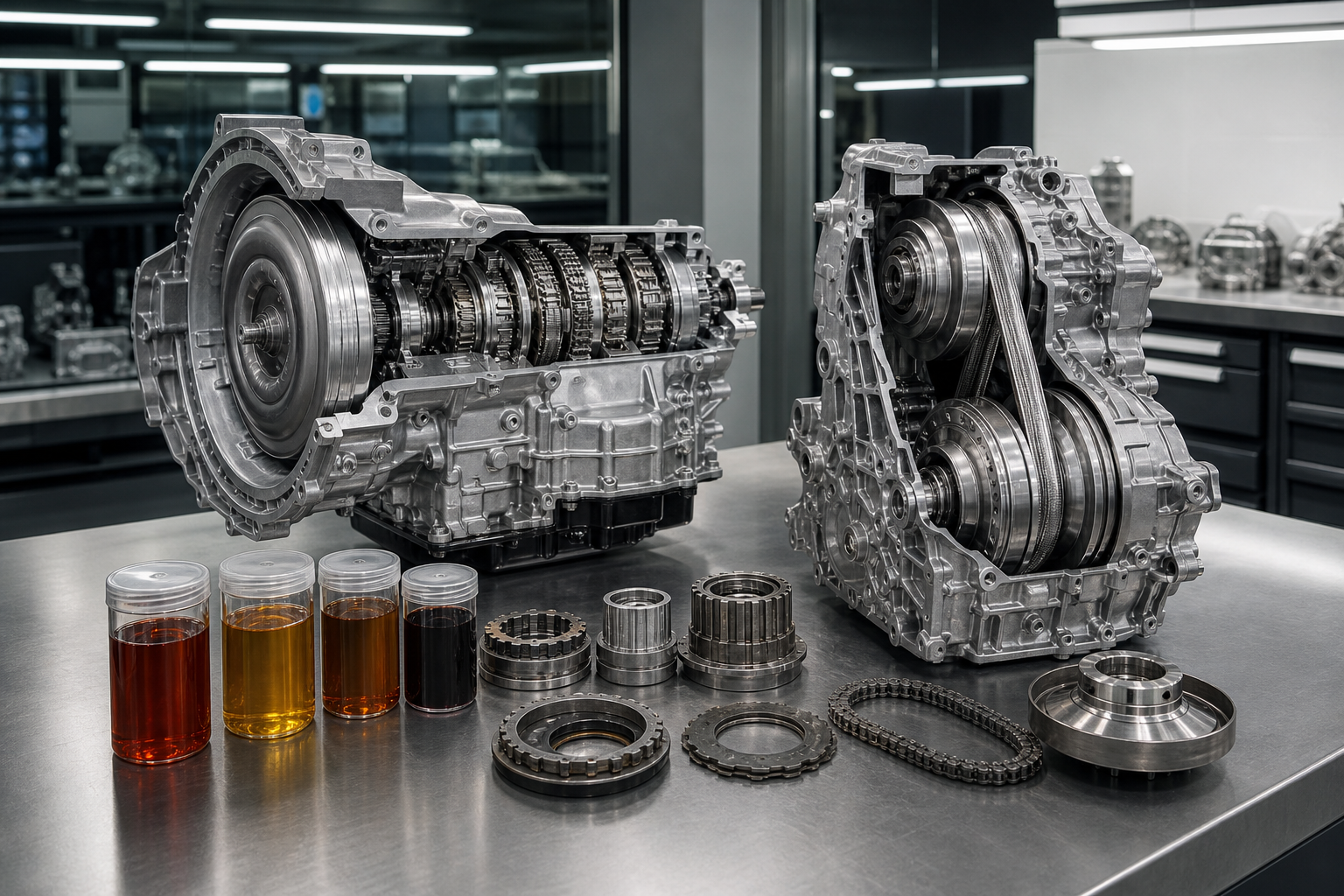
The fundamental split is straightforward: Matic S is automatic transmission fluid (ATF) for certain conventional stepped automatic transmissions; NS-2 and NS-3 are fluids for Nissan belt-type continuously variable transmissions (CVTs). Nissan documentation specifically warns against putting ATF into a Nissan CVT and, in applicable conventional automatics, against using CVT fluid instead of Matic S.
Matic S: fluid for certain conventional automatics
A conventional automatic transmission uses fixed gear ratios, typically selected through planetary gearsets and hydraulically controlled clutches. Its fluid must provide hydraulic control, wear protection, heat resistance and carefully calibrated friction at the internal clutch packs and torque converter lock-up clutch.
Matic S is Nissan’s requirement for a range of conventional automatic transmissions, including certain five- and seven-speed units. It is not a viscosity grade such as SAE 75W-90, and the label does not mean that every Nissan automatic transmission uses it. Older applications may call for Matic D, J or K; some hybrid transaxles and newer transmissions can have other requirements.
There is one important, limited compatibility statement in Nissan material: some applications that specify Matic S allow Matic J if Matic S is unavailable. That is a vehicle- and transmission-specific instruction, not evidence that Matic J, Matic S and every other Nissan ATF are freely mixable. A service shop should follow the exact manual, under-hood label or parts catalog entry for the vehicle identification number.
NS-2 and NS-3: fluids for different generations of Nissan CVT
A belt CVT does not operate like a conventional stepped automatic. In a typical Nissan Xtronic design, a steel belt or chain runs between variable-diameter pulleys, changing the ratio continuously rather than moving among a set number of gears. The fluid must transmit hydraulic pressure, protect components from wear and maintain the friction conditions needed to transfer torque at the belt-and-pulley contact. Heat control is also central to durability.
That operating environment explains why ordinary ATF is not an acceptable substitute for a CVT fluid. An ATF can have the wrong friction behavior, viscosity-temperature response or additive balance for the pulley-and-belt system, even if the bottle describes it as “synthetic” or lists many broad applications.
NS-2 is associated with earlier Nissan CVT applications. Nissan’s earlier service documentation identifies NS-2 as the required fluid for the CVTs covered by that document and says not to mix it with other fluids. NS-3 is the requirement found in many later Nissan CVT manuals and is the fluid Nissan identifies for current Xtronic CVT applications.
Crucially, NS-3 is not automatically a back-service replacement for an NS-2 vehicle. A current Nissan webpage’s discussion of its present Xtronic range does not rewrite the service requirement for an older CVT. Conversely, an NS-2 bottle is not an acceptable choice simply because it is genuine Nissan fluid. The exact model year, transmission and manufacturer documentation control.
| Fluid name | General application | What it must not be assumed to replace |
|---|---|---|
| Nissan Matic S | Specified conventional automatic transmissions | NS-2, NS-3, or every older Nissan ATF |
| Nissan CVT Fluid NS-2 | Specified earlier Nissan CVTs | NS-3 or conventional ATF requirements |
| Nissan CVT Fluid NS-3 | Specified later/current Nissan CVTs | NS-2 in every earlier CVT, or Matic S |
What “equivalent” means—and what it does not mean
Some Nissan manuals permit genuine fluid or equivalent. That does not mean any multi-vehicle transmission fluid is acceptable. A credible alternative should make a precise, product-specific statement that it meets the applicable Nissan requirement: for example, Matic S or CVT Fluid NS-3. Vague wording such as “recommended for most CVTs” is weaker than an explicit claim for the required fluid.
Even an explicit claim needs to be read carefully. It must match the fluid named in the vehicle documentation, not merely a related Nissan name. Do not infer NS-2 coverage from an NS-3 claim, or CVT coverage from a Matic S claim. Also distinguish a manufacturer approval or license from a blender’s own “suitable for” or “recommended for” statement; they are not automatically the same kind of claim. For a broader framework, see why universal ATF requires verification.
Service procedure matters as much as the bottle
Correct fluid selection does not guarantee correct service. CVTs and modern automatics can require a defined fluid-temperature range, a level-setting procedure, scan-tool functions, new sealing washers or a specified fill sequence. Overfilling, underfilling and contamination can all cause problems. Nissan commonly directs owners to a dealer when CVT fluid inspection or replacement is required; that reflects the importance of the procedure, not only the product.
Do not use fluid color as identification. New fluid can vary by supplier or production revision, while used fluid changes color with age and heat. Likewise, do not choose by transmission marketing language alone: a vehicle described as “automatic” may have a conventional automatic, a belt CVT, a hybrid transaxle or another design with a different fluid requirement.
A practical verification checklist
Identify the exact model year, engine, drivetrain and transmission—not just the vehicle name.
Check the current owner’s manual and service literature for the stated fluid name.
Confirm the transmission type: conventional automatic versus CVT is the critical first split.
Match the replacement bottle’s explicit claim to the required Nissan fluid designation.
Follow the correct level-setting and temperature procedure, or use a qualified service facility.
Never mix NS-2, NS-3 and Matic S merely to top up a system unless Nissan documentation for that exact application expressly permits it.
The safe conclusion is simple: Matic S, NS-2 and NS-3 are distinct service-fluid requirements tied to transmission design and application. Verify the current manufacturer documentation for the exact vehicle before purchase or service.