What JASO DH-2, DL-1 and DL-2 mean
JASO DH-2, DL-1 and DL-2 are performance classifications for four-stroke diesel engine oils. They sit within the JASO M 355 automotive diesel-oil standard, which is separate from the better-known JASO motorcycle-oil classifications. The letters are not viscosity grades, brand names or simple generations of the same oil. They identify oils designed around particular diesel-engine duty classes and emissions hardware.
The practical split is important:
DH-2 is intended for heavy-duty truck and bus applications.
DL-1 is intended for light-duty, passenger-car-class diesel applications.
DL-2 is also intended for light-duty, passenger-car-class diesel applications, but has a different sulfated-ash range from DL-1.
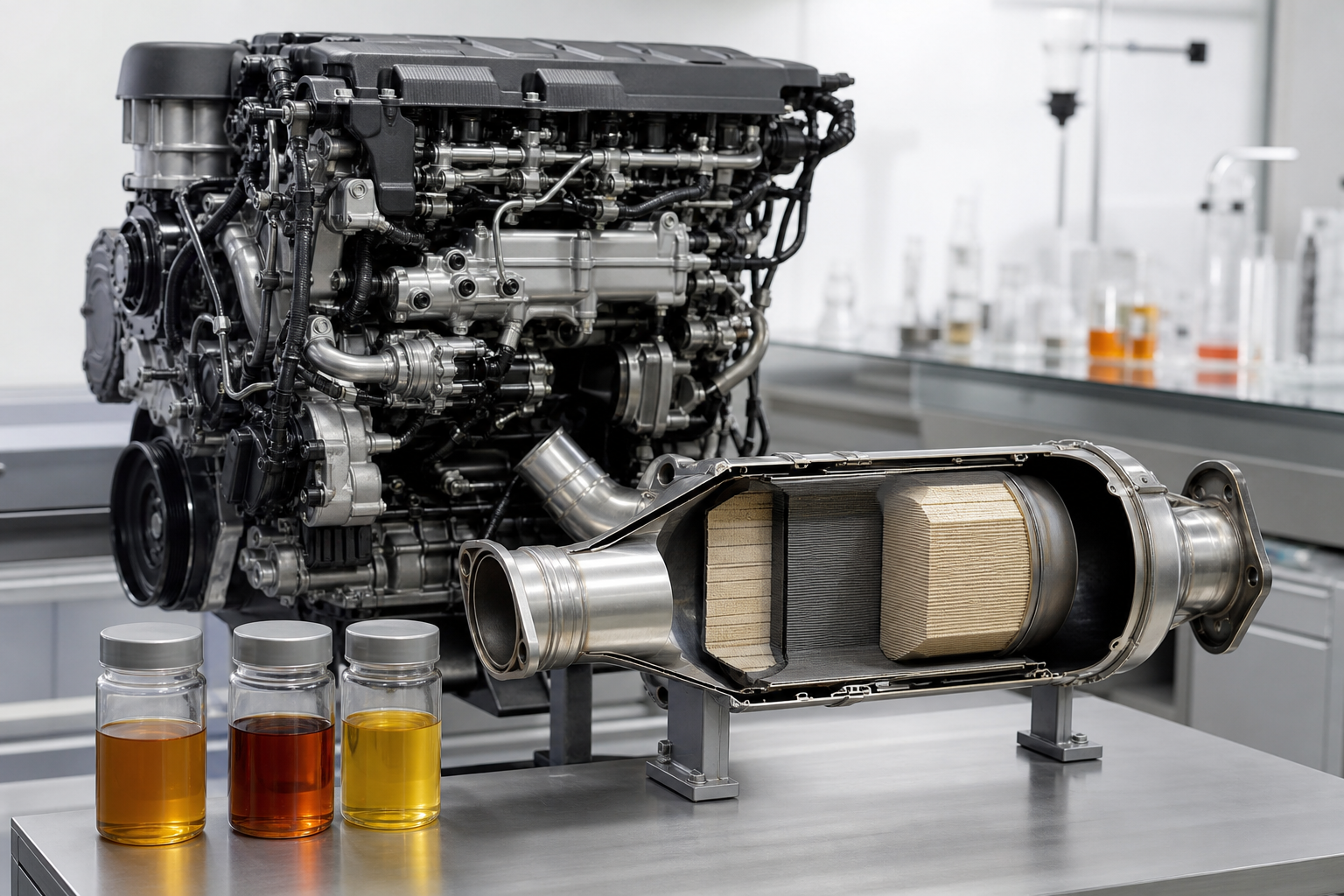
All three classifications were developed for engines with exhaust aftertreatment, such as a diesel particulate filter (DPF) or catalyst. They therefore control not only engine-protection performance but also chemical properties that influence aftertreatment durability. That does not make them interchangeable with each other, with an API diesel category, or with an ACEA sequence.
Why diesel aftertreatment changes the oil requirement
Every engine oil contains an additive package. Some additives leave inorganic residues when small amounts of oil are consumed during normal operation. This residue is commonly measured as sulfated ash. Unlike soot, ash cannot be burned away during a DPF regeneration event. Too much ash can gradually occupy filter volume and contribute to higher exhaust backpressure over the life of the vehicle.
Phosphorus and sulfur are also controlled because they can affect emissions-control components. JASO created DH-2 and DL-1 in response to these newer diesel emissions systems, then added DL-2 in the 2021 revision of JASO M 355. The subsequent M 355:2024 revision retained the classifications while updating reference oils used in certain tests.
Oil chemistry is only one part of the classification. JASO M 355 also includes requirements or limits covering such areas as piston cleanliness, valve-train wear, soot-related viscosity increase, oxidation resistance, foaming, volatility, corrosion, shear stability and seal compatibility. In plain English, a correct oil must preserve its protective properties in the intended engine environment as well as be compatible with its emissions hardware.
The key difference: heavy-duty versus light-duty, then ash level
| Classification | Intended duty class | Practical emphasis |
|---|---|---|
| JASO DH-2 | Heavy-duty trucks and buses | Aftertreatment-compatible heavy-duty diesel performance, including control of soot-related thickening and durability demands associated with commercial service. |
| JASO DL-1 | Passenger-car-class diesels | Very low sulfated ash: no more than 0.6% by mass under the current JASO criteria. |
| JASO DL-2 | Passenger-car-class diesels | Aftertreatment-compatible light-duty diesel oil with a higher, tightly defined sulfated-ash window: 0.7% to 0.8% by mass. |
The DL-1 and DL-2 distinction is easily misunderstood. DL-2 is not automatically an improved or backward-compatible version of DL-1. DL-1 has the lower ash limit, while DL-2 was introduced to accommodate light-duty oils aligned with the sulfated-ash range used by ACEA C2, C3 and C5. An engine designed around DL-1 may require that lower ash level; an engine requiring DL-2 may also have other performance expectations beyond ash content.
Likewise, DH-2 is not simply “DL-1 for trucks.” Heavy-duty engines face different durability, drain-interval, soot-control and operating-load demands. JASO explicitly separates the truck/bus and passenger-car classes for that reason.
Do not treat JASO as a viscosity grade or an API/ACEA substitute
A container marked 5W-30 DL-1 and one marked 5W-30 DL-2 may have the same SAE viscosity grade, yet still be unsuitable substitutes. The viscosity grade describes how the oil flows at specified low and high temperatures; it does not reproduce the full additive chemistry or engine-test performance behind the JASO classification. See how oil viscosity works for the distinction.
The same caution applies to API and ACEA claims. An oil can legitimately carry more than one performance claim, but the claims must be checked individually. A comparable-looking ACEA category does not by itself prove that an oil meets a vehicle maker’s specified JASO requirement. For more context, read why an ACEA sequence is not a vehicle approval.
Also avoid guessing from the packaging phrase “low SAPS,” “DPF compatible” or “diesel.” Those descriptions may be helpful marketing shorthand, but they are broader than a precise JASO classification and cannot establish suitability for one particular engine.
What DH-2F, DH-1 and DL-0 add to the picture
The wider JASO M 355 family also includes DH-1, DH-2F and DL-0. DH-2F is a heavy-duty classification that adds defined fuel-economy performance to DH-2-type use. DH-1 and DL-0 are different classifications associated with older emissions-control contexts, so neither should be assumed to replace DH-2, DL-1 or DL-2.
This reinforces the central rule: the letters and numbers are application identifiers, not a universal ranking. A newer-looking label is not automatically right for an older engine, and a lower-ash oil is not automatically a safe upgrade.
How to verify an oil before service
Start with the current owner’s manual, service information or manufacturer bulletin for the exact engine and market.
Record every requirement: viscosity grade, JASO class, API or ACEA category, and any manufacturer approval or named oil specification.
Check the lubricant maker’s current technical data sheet, not only the front-label wording.
If JASO conformance matters, look for a clear, specific DH-2, DL-1 or DL-2 claim and, where available, the product’s JASO oil code or on-file listing.
Do not extend drain intervals because an oil carries a different or additional classification. Follow the vehicle manufacturer’s applicable service schedule.
JASO’s diesel-oil system is an on-file program: the product marketer is responsible for its quality, performance and marking. That makes careful documentation especially valuable. For motorists and workshops, the safe choice is the oil that matches the vehicle manufacturer’s complete current requirement—not merely the closest-looking JASO letters on the shelf.