Mercedes-Benz gear-oil sheet numbers are approval categories
Mercedes-Benz uses 235.xx sheet numbers to identify approved gear oils for particular driveline assemblies. These are not SAE viscosity grades, and they are not simple equivalents of an API service category such as GL-5. A rear differential, front axle, transfer case and manual transmission can all contain gears, yet require fluids with different viscosity, friction, extreme-pressure and durability characteristics.
For passenger cars, SUVs and vans, the Mercedes-Benz operating-fluids system directs technicians to a vehicle and major-assembly application overview before choosing an oil from an approved sheet. That order matters: identify the exact axle or transmission first, then use the specified sheet number, then select a currently listed product. Do not select fluid merely because its bottle says “Mercedes compatible,” “synthetic,” or “75W-90.”
The three labels most likely to cause confusion are MB 235.0, MB 235.7 and MB 235.74. They all relate to hypoid gear applications, but they do not form a universal upgrade ladder.
What “hypoid gear oil” means
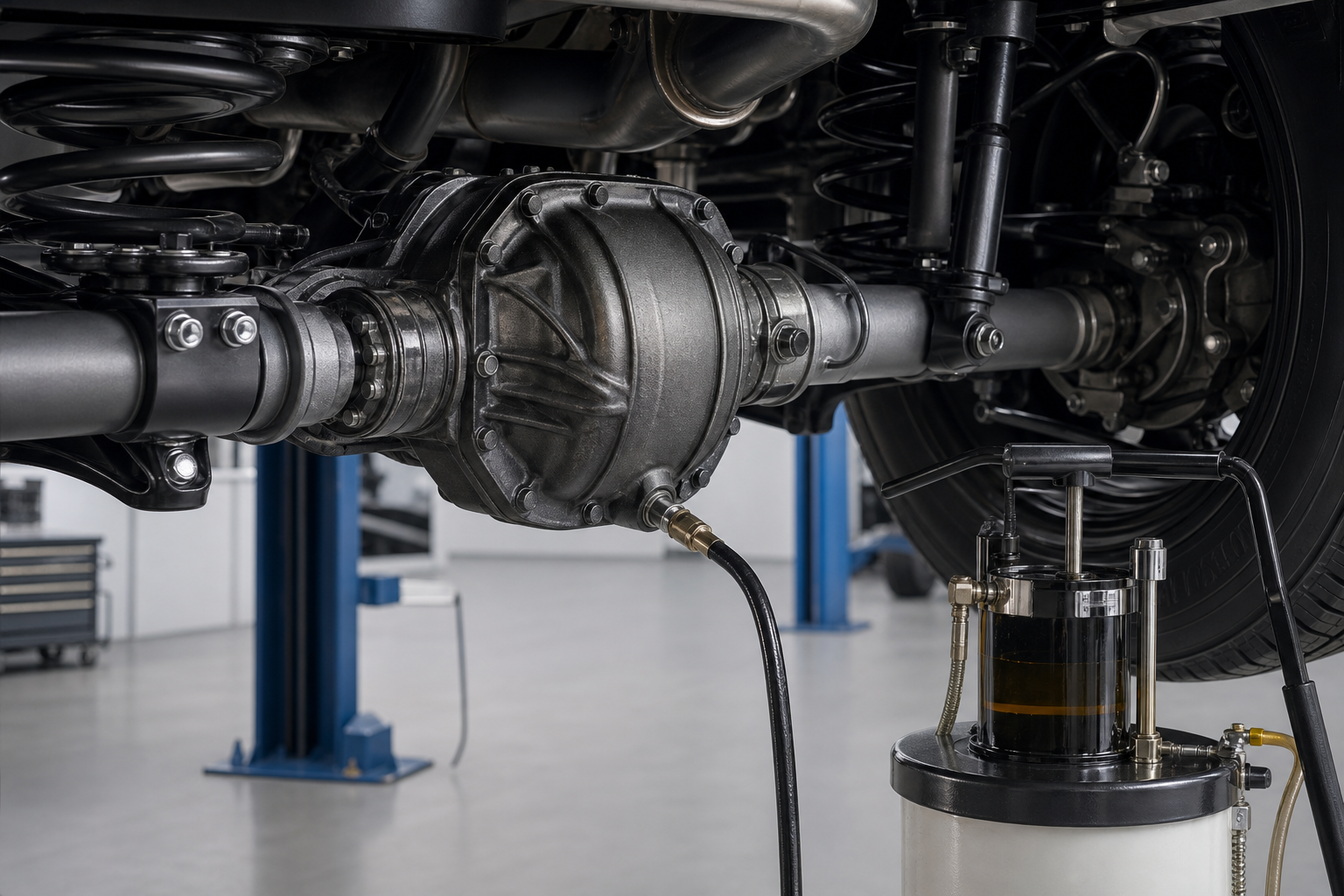
A hypoid final drive uses ring-and-pinion gears whose shafts are offset rather than intersecting at a common centerline. The design is compact and quiet, but the gear teeth experience substantial sliding contact and pressure. The lubricant therefore needs robust film strength and extreme-pressure protection. Its friction behavior also has to suit the particular differential design, especially where a locking or limited-slip function is present.
This is why a broad API GL-4 or GL-5 claim does not by itself prove that an oil meets a Mercedes-Benz sheet. API categories describe general performance classifications; a Mercedes-Benz approval is a manufacturer-specific requirement and approval listing.
MB 235.0: an older, now historical hypoid-oil sheet
MB 235.0 was used for conventional hypoid gear oils in a range of older Mercedes-Benz axle applications. The currently published Mercedes-Benz entry is designated 235.0H, where the H denotes historical status. Mercedes-Benz states that no new products are approved under this historical sheet. The current list includes oils in several viscosity grades, including 75W-90, 80W-90, 85W-90 and straight SAE 90.
That history does not make the requirement irrelevant. If a vehicle’s service information calls for 235.0, the vehicle still needs a suitable fluid for that specification and application. It does mean that a motorist should be particularly careful with old product literature and generic catalog lookups. A newer Mercedes-Benz gear-oil sheet is not automatically backward-compatible, even if its viscosity looks similar or its marketing describes it as an improvement.
For an older vehicle, verify whether the manufacturer has issued a supersession for the exact axle. If no supersession is stated, use a product that is explicitly approved for the required historical sheet or obtain direction from Mercedes-Benz service information.
MB 235.7: fuel-economy hypoid gear oil
MB 235.7 is a current Mercedes-Benz approval sheet for hypoid gear oils. The official product list shows 75W-85 products, a lower-viscosity range than the heavier oils commonly associated with older axle specifications. Lower viscosity can reduce churning and fluid drag, which can support efficiency, particularly during cold operation. But it also means that MB 235.7 is a formulated performance target, not simply a request for “thin differential oil.”
Mercedes-Benz-approved 235.7 products may be marketed as fuel-economy hypoid oils. The important point is the approval itself. Two oils both labeled 75W-85 may differ in additive system, low-temperature behavior and tested suitability. Likewise, an oil that meets a general GL-5 category may not have Mercedes-Benz approval 235.7.
Do not use MB 235.7 as a blanket substitute for MB 235.0. An older axle may require the viscosity and chemistry associated with its original approval, while a newer axle may have been engineered around the lower-viscosity 235.7 fluid.
MB 235.74: front-axle listing, not a “better” version number
MB 235.74 is an approval sheet identified by Mercedes-Benz for front-axle gear-oil applications. The official listing also shows 75W-85 products, and some approved products carry both 235.7 and 235.74 approvals. That overlap is useful, but it should not be misread as a general rule that the two numbers always mean the same service fill.
The distinction is application-based. Mercedes-Benz uses 235.74 to identify the relevant front-axle application group; 235.7 is the companion hypoid-oil approval commonly seen on the same dual-approved products. The vehicle’s assembly application remains decisive, particularly on all-wheel-drive vehicles where the front axle, rear axle and transfer case may have separate fluid requirements.
| Sheet | Plain-English role | Key service point |
|---|---|---|
| MB 235.0 / 235.0H | Historical conventional hypoid gear-oil requirement | Do not assume a current low-viscosity oil replaces it. |
| MB 235.7 | Current 75W-85 hypoid gear-oil approval | Use only where the exact axle application specifies it. |
| MB 235.74 | Front-axle gear-oil application approval | Confirm the front-axle requirement; dual approval on a product is not a universal permission. |
How to verify the correct gear oil
Identify the vehicle by VIN and establish whether the service point is a front axle, rear axle, transfer case, manual transmission or automatic transmission.
Consult current Mercedes-Benz owner, workshop or operating-fluid documentation for the required sheet number and any stated viscosity.
Check the lubricant maker’s current product data and approval wording. Prefer an explicit “MB-Approval” statement over a vague claim that the product is merely recommended or suitable.
Where the official Mercedes-Benz approved-products list is available, confirm that the exact product appears under the required sheet.
Use the specified fill quantity and service procedure. On many driveline units, correct level setting depends on vehicle position and fluid temperature.
Mercedes-Benz 235.0, 235.7 and 235.74 are therefore not competing descriptions of one generic differential oil. They identify distinct approval and application paths. The safest choice is the fluid that matches the exact current manufacturer requirement for the installed axle or driveline assembly, not the fluid with the newest-looking number or the closest viscosity on the shelf.