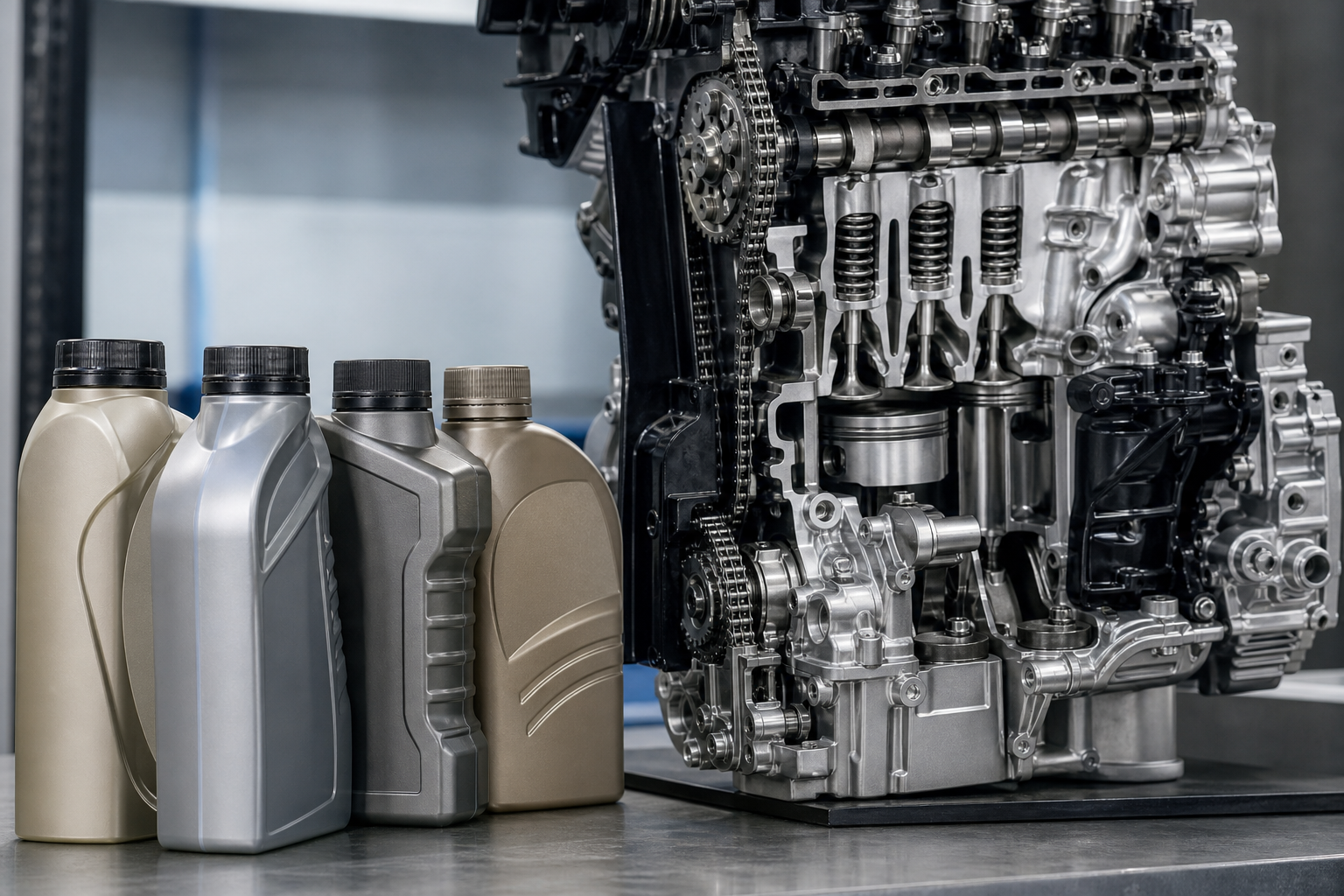
Peugeot, Citroën, DS, Opel and Vauxhall vehicles can present an especially confusing oil-label problem. A service document may specify a legacy PSA B71 number, while newer lubricant literature may refer to a Stellantis FPW approval. At the same time, several oils may share an SAE viscosity grade such as 5W-30 but have very different performance credentials.
The practical rule is simple: treat the code in the current maintenance documentation as the requirement. Viscosity, ACEA sequence and API category provide useful supporting information, but they do not by themselves prove that an oil meets the vehicle-maker requirement. This is the same distinction explained in our guide to ACEA engine-oil claims and vehicle approvals.
What the PSA B71 and Stellantis FPW codes mean
PSA B71 numbers are proprietary engine-oil specifications developed for Peugeot and Citroën applications. Following the creation of Stellantis, newer requirements may use a Stellantis code, such as FPW9.55535/03. These codes identify a defined lubricant performance target for particular engines and operating conditions. They are not a simple ranking from older to newer, or from “basic” to “better.”
Oil selection therefore starts with the exact code, then confirms the required SAE viscosity and service interval. A newer-looking code should not be assumed to replace an older one unless the vehicle manufacturer’s documentation or the oil’s formal approval statement explicitly says so.
PSA B71 2290: a common low-SAPS 5W-30 requirement
PSA B71 2290 is widely encountered on earlier Peugeot, Citroën, DS and related applications. Oils marketed against it are commonly SAE 5W-30 and often carry an ACEA C2 claim. “C2” indicates a mid-SAPS, fuel-economy-oriented European category: it limits certain ash-forming additive components to help protect exhaust after-treatment systems, while also setting fuel-economy and engine-protection performance requirements.
However, ACEA C2 is not interchangeable with B71 2290. An oil can claim ACEA C2 yet lack the PSA claim, and an oil carrying B71 2290 may have additional manufacturer credentials that do not make it correct for every engine. Check the product data sheet or label for the precise wording, such as “PSA B71 2290 approved” or “meets PSA B71 2290,” and compare that wording with the owner’s manual.
For vehicles fitted with diesel particulate filters, the low- or mid-SAPS chemistry associated with the required oil is particularly important. Substituting a conventional high-ash oil simply because it is also 5W-30 can work against the emissions-system design.
PSA B71 2297: do not overlook the climate qualification
PSA B71 2297 is also associated with 5W-30 oils, but it must not be treated as a generic duplicate of B71 2290. Stellantis documentation identifies B71 2297 as an approval for hot-climate countries. That distinction matters because an oil requirement may vary with the market and operating-temperature assumptions built into the manufacturer’s maintenance schedule.
In other words, finding “5W-30” on both products does not establish that they are substitutes. Nor does a product’s stated suitability for B71 2290 automatically establish formal B71 2297 approval. Where the manual names B71 2297, use an oil that makes that exact claim and follow the vehicle’s market-specific documentation.
PSA B71 2312: why 0W-30 is not just a thinner 5W-30
PSA B71 2312 is commonly found on SAE 0W-30, low-SAPS oils, often alongside ACEA C1. The “0W” portion describes low-temperature cranking and pumping performance; it does not mean the oil is automatically suitable for any engine calling for a 0W grade. Likewise, the “30” indicates an SAE high-temperature viscosity range, not a complete performance specification.
A manufacturer manual for a related Opel application illustrates the distinction clearly by listing B71 2312 with 0W-30 and B71 2297 with 5W-30. The same manual also includes B71 2010 with 0W-20 for certain applications. This is a useful reminder that both the approval code and viscosity can be engine- and market-specific.
Do not replace a specified B71 2312 0W-30 with a B71 2290 5W-30 merely because both oils are described as low-SAPS or suitable for diesel engines. They may differ in low-temperature behavior, fuel-economy design and the full set of manufacturer performance tests.
Stellantis FPW9.55535/03: a newer 5W-30 approval
Stellantis FPW9.55535/03 is a newer formal approval for a high-performance 5W-30 engine oil. Stellantis has identified applications including certain 1.5 BlueHDi DV5R diesels, 1.2 EB Turbo gasoline engines and DW12RU engines, while directing owners and workshops back to the maintenance plan for the final application decision.
Stellantis describes this approval in terms of 5W-30 viscosity, optimized CO2 performance, wear protection and deposit control. Those objectives are important, but they do not make every 5W-30 oil equivalent. The reliable purchase check is an explicit FPW9.55535/03 approval on the technical data sheet or packaging—not a vague statement that the oil is “for Peugeot,” “for PSA,” or “for Stellantis.”
How to read an oil label correctly
Find the exact requirement: Use the owner’s manual, maintenance plan or official service information for the engine and market.
Match the SAE viscosity: Confirm the specified grade, such as 0W-30 or 5W-30. Learn what those numbers mean in our oil-viscosity guide.
Look for the exact PSA or Stellantis code: Do not infer compliance from ACEA C1, C2, C3, API or viscosity alone.
Check the claim type: “Approved,” “approval,” “meets requirements” and “recommended for” are not necessarily equivalent commercial statements. When an approval is required, prefer a product that states the exact formal approval.
Keep the drain interval separate: Correct oil does not override the manufacturer’s time-, mileage- or oil-life-monitor limit. See our explanation of oil drain intervals.
For any Peugeot, Citroën, DS, Opel or Vauxhall vehicle, the current manufacturer documentation remains decisive. The PSA B71 and Stellantis FPW codes are useful because they narrow oil choice to the chemistry and performance level intended for the engine—but only when matched exactly to the vehicle requirement.