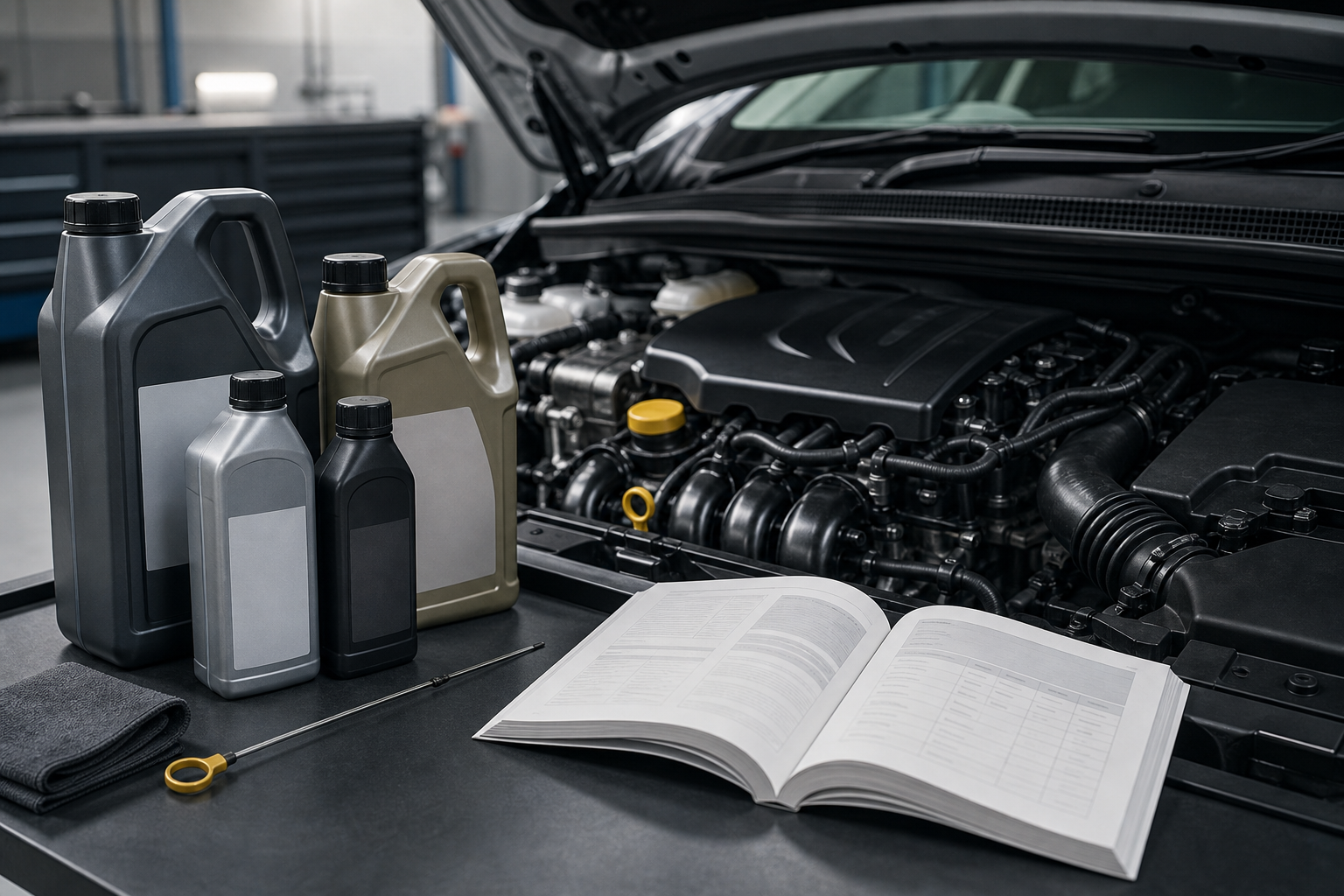
A Renault oil requirement beginning with RN is a manufacturer specification: it identifies the performance profile Renault requires for a particular engine and service application. It is not simply a description of oil thickness. A 0W-20 RN17 FE oil and a 5W-30 RN17 oil may both be modern synthetic products, but they are intended for different stated requirements and must not be treated as substitutes.
The practical rule is straightforward: start with the exact RN specification and SAE viscosity in the current owner’s documentation for the vehicle, then select an oil whose current technical data sheet explicitly states that approval or requirement. The oil’s API or ACEA claim can provide useful context, but it does not override Renault’s own requirement. For a fuller explanation of that distinction, see why an ACEA sequence is not a vehicle approval.
What the Renault RN number tells you
Renault RN specifications were developed around particular engine families, emissions hardware, fuel-economy targets and drain-interval expectations. The number therefore matters alongside viscosity. The “W” part of an SAE grade describes low-temperature flow behavior, while the second number indicates an oil-viscosity range at operating temperature; neither number describes ash content, oxidation resistance, deposit control, after-treatment compatibility or every wear test required by Renault. Read more about the viscosity label in What is Oil Viscosity?.
RN labels also coexist because Renault maintains vehicles from several generations. A newer specification is not automatically a universal replacement, even when it appears on a newer oil bottle.
| Specification | Practical meaning | Key caution |
|---|---|---|
| RN0700 | An earlier Renault requirement still encountered on older petrol and diesel applications. | Do not infer suitability from an API or ACEA claim alone. |
| RN0710 | An earlier Renault requirement commonly associated with oils for more demanding older applications. | RN0710 is a requirement, not a synonym for 5W-40. |
| RN0720 | A Renault requirement widely associated with earlier diesel applications fitted with a particulate filter. | It is often printed as “RN720” on packaging, but the formal designation is RN0720. |
| RN17 | A later Renault approval used broadly across many newer petrol and diesel applications. | Use the specified viscosity as well as RN17; RN17 does not turn every 5W-30 into an RN17 oil. |
| RN17 FE | A distinct fuel-economy-focused Renault approval, commonly supplied as 0W-20. | It is specifically stated not to be backward compatible with the other RN specifications listed here. |
RN0700 and RN0710: older does not mean irrelevant
RN0700 and RN0710 remain important because many Renault and Dacia vehicles on the road were designed around them. Oils approved to RN0700 can be found in more than one viscosity grade, and the same is true of RN0710. That alone demonstrates why selecting “the usual 5W-40” or “the usual 5W-30” is an unreliable shortcut.
Renault’s current Renault-Castrol recommendation material states that RN17 is suitable where RN0700 or RN0710 is required. That is useful guidance for applications covered by that material, but it should not be expanded into a general rule that any newer oil can replace any older Renault oil. Check the vehicle’s engine code, model year, market and current manual—especially if the engine is a high-performance version or has unusual service conditions.
RN0720: particulate-filter compatibility is central
RN0720 is particularly significant for earlier Renault diesel applications with a diesel particulate filter (DPF). Oils marketed with this approval are typically formulated to manage the sulphated ash, phosphorus and sulphur characteristics that matter to exhaust after-treatment durability. Ash does not disappear during combustion; excessive ash can accumulate in a particulate filter over time. That is why an otherwise reputable conventional high-ash oil may be inappropriate even if it has the same SAE viscosity.
Do not assume that every diesel with a DPF requires RN0720, or that every vehicle without one can use it. Renault’s more recent recommendation charts include applications where later Blue dCi diesel engines use RN17 rather than RN0720. Engine generation matters. The exact requirement in the manufacturer documentation remains decisive.
RN17: a later approval, but still not a viscosity grade
RN17 appears prominently in later Renault and Dacia service recommendations, often in 5W-30. Approved RN17 oils may also carry ACEA C2 and C3 claims, indicating that they satisfy defined industry performance sequences in addition to their Renault approval. Those extra claims are helpful, but the RN17 approval is the relevant confirmation for an engine that specifies RN17.
It is also important to distinguish an approval from wording such as “meets requirements” or “suitable for.” Product labels and data sheets should identify the status clearly. When an approval is required, prefer a product whose technical documentation uses explicit approval language and is current for the exact formulation. A brand can sell several oils in the same viscosity grade with different approval portfolios.
RN17 FE: the most common substitution trap
The suffix FE means fuel economy, but it should not be read as “an improved RN17 that fits every Renault.” RN17 FE is a separate low-viscosity approval, commonly 0W-20, and lubricant documentation states that it is not backward compatible with RN0700, RN0710, RN0720, RN17 or RN17 RSA. If the manual calls for RN17 FE, use an oil explicitly approved to RN17 FE. If it calls for one of the other RN standards, do not downgrade the decision to “0W-20 is newer.”
There is a further modern distinction: some Renault hybrid applications call for AN2022 0W-16 rather than RN17 FE. This reinforces the same lesson: the newest-looking or thinnest oil is not automatically correct.
A reliable selection process
Identify the exact engine, model year and market version.
Read the current owner’s manual or official service information for both the required RN code and viscosity.
Confirm the claim on the product’s current technical data sheet, not only on a retailer listing.
Do not substitute RN17 FE for RN17, RN0720, RN0710 or RN0700 unless Renault documentation specifically authorizes it.
Follow the vehicle’s specified maintenance schedule and severe-service provisions; oil approval does not extend an oil-change interval on its own. See About Oil Drain Intervals.
In short, Renault RN codes are an essential part of oil selection. Match the manufacturer requirement first, viscosity second, and broad industry categories after that.