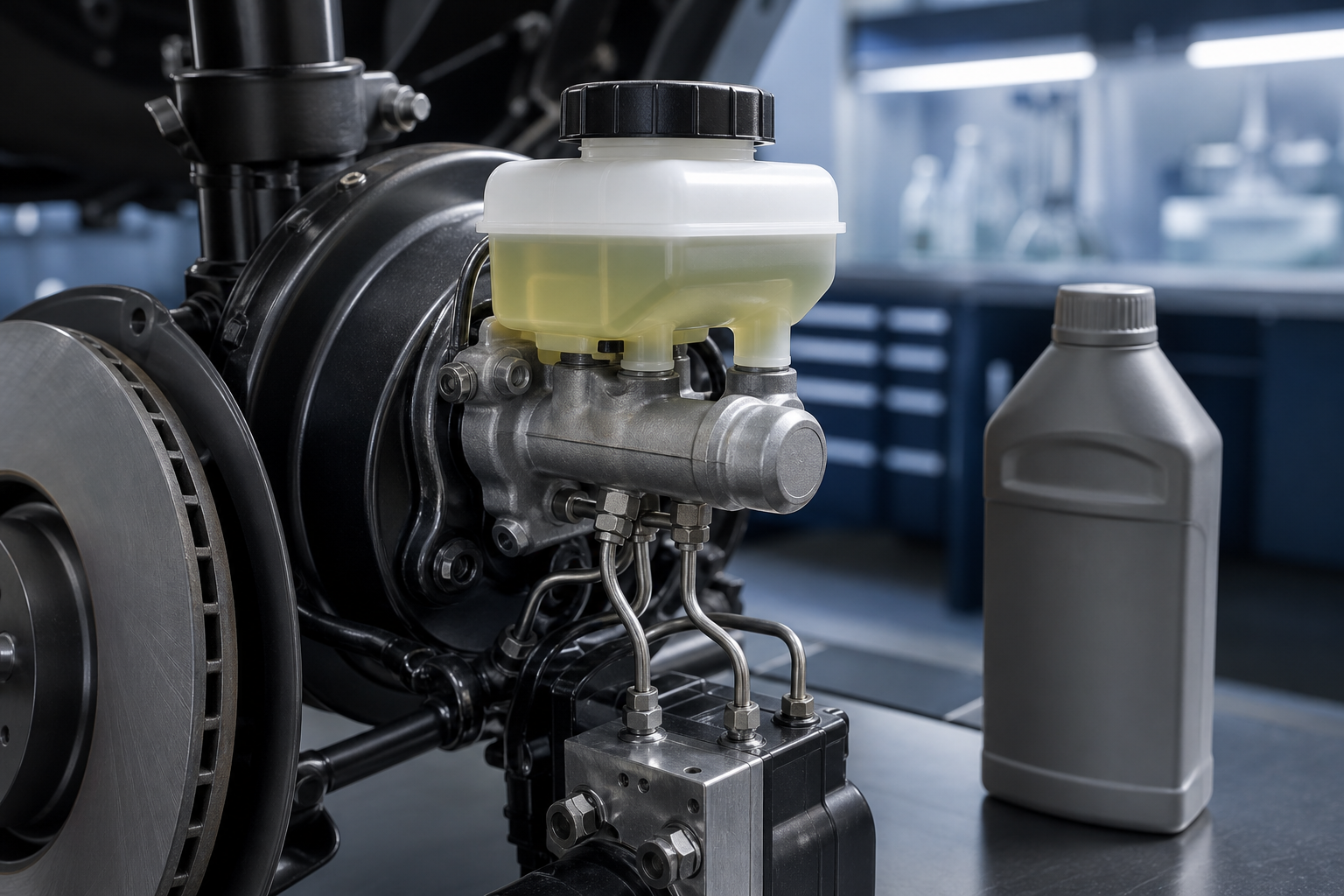
Brake-fluid containers can look deceptively simple: DOT 3, DOT 4, DOT 5 or DOT 5.1. Those labels are important, but they are not a simple performance ladder in which the highest number is automatically best. They identify brake-fluid categories with minimum performance requirements, including boiling point, low-temperature viscosity, corrosion control and compatibility with brake-system materials.
For a motorist or technician, the first rule is straightforward: use the fluid specified in the current documentation for the exact vehicle. A DOT grade is not a substitute for an automaker’s own requirement, especially where a modern ABS, stability-control or brake-by-wire-related hydraulic system requires a low-viscosity fluid. The general role of boiling point, viscosity and moisture resistance is also covered in our guide to brake-fluid properties.
What the DOT designation means
In the United States, Federal Motor Vehicle Safety Standard No. 116 sets requirements for DOT 3, DOT 4 and DOT 5 brake fluids. The regulation tests more than boiling point: it also addresses low-temperature flow, chemical stability, corrosion, oxidation resistance, water tolerance, rubber-cup effects and performance in a simulated hydraulic system.
“Dry” equilibrium reflux boiling point (ERBP) is measured on new fluid. “Wet” ERBP is measured after a defined moisture-conditioning procedure. The wet figure is therefore useful because ordinary glycol-based brake fluids can absorb water from the atmosphere over time. It is not a measurement of the moisture percentage in one particular vehicle’s reservoir.
| FMVSS 116 grade | Minimum dry ERBP | Minimum wet ERBP | Maximum viscosity at -40°C |
|---|---|---|---|
| DOT 3 | 205°C / 401°F | 140°C / 284°F | 1,500 mm²/s |
| DOT 4 | 230°C / 446°F | 155°C / 311°F | 1,800 mm²/s |
| DOT 5 | 260°C / 500°F | 180°C / 356°F | 900 mm²/s |
These are minimum category values, not a complete ranking of every product. Two DOT 4 fluids can have substantially different actual boiling points, low-temperature viscosity and manufacturer approvals. Likewise, a higher advertised boiling point does not prove that a fluid meets the vehicle maker’s required viscosity or chemistry.
DOT 3 and DOT 4: conventional glycol-based service fluids
DOT 3 and DOT 4 fluids used in passenger vehicles are normally non-petroleum, glycol-ether-based formulations. DOT 4 has higher regulatory minimum dry and wet boiling points than DOT 3, which helps explain its common use in vehicles expected to generate more brake heat. But it is not automatically an approved replacement for DOT 3 in every car.
The owner’s manual may permit both grades, name only one grade, or add a manufacturer material specification. For example, a current Toyota manual permits either an FMVSS 116 DOT 3/SAE J1703 fluid or an FMVSS 116 DOT 4/SAE J1704 fluid for that vehicle. That does not establish the same substitution rule for every Toyota, much less every make.
Both grades require clean handling. Keep the reservoir opening and cap clean, use fluid from a sealed container, and close the bottle promptly. Water, dirt, petroleum products and unsuitable fluids can compromise braking-system performance or components. A low fluid level also deserves diagnosis: pad wear can lower the level gradually, but repeated need for topping up can indicate a leak or other fault.
DOT 4 LV: the low-temperature-viscosity detail
DOT 4 LV means low-viscosity DOT 4. It is often associated with electronic brake-control systems that must move fluid quickly at low temperature. “LV” is therefore not a claim that the fluid is thin at all temperatures or that it is merely a premium DOT 4.
Importantly, DOT 4 LV is not a standalone FMVSS 116 grade alongside DOT 3, DOT 4 and DOT 5. Vehicle manufacturers commonly connect it to an additional company specification or an ISO 4925 class. Ford, for example, specifies DOT 4 LV fluid meeting WSS-M6C65-A2 or ISO 4925 Class 6 for certain vehicles. If a manual calls for DOT 4 LV or a named manufacturer standard, selecting an ordinary DOT 4 solely because its label has a high boiling-point claim is not enough.
DOT 5: silicone-based and not the next step after DOT 4
DOT 5 is the exception that causes most confusion. It is silicone-based, and federal labeling distinguishes it as “DOT 5 SILICONE BASE.” It must not be treated as a routine upgrade from glycol-based DOT 3 or DOT 4. Its different chemistry and water behavior make it a vehicle- and system-specific choice.
Do not convert a brake system to DOT 5 simply because its label shows a higher boiling-point minimum. Follow the vehicle manufacturer’s service procedure and fluid requirement. This is particularly important on vehicles with complex electronic hydraulic controls. A fluid choice is only correct when both the DOT designation and the manufacturer requirement match.
DOT 5.1: despite the number, it is non-silicone
DOT 5.1 is easy to misread. It is not silicone DOT 5. Under FMVSS 116 labeling rules, it is identified as “DOT 5.1 NON-SILICONE BASE.” DOT 5.1 products are typically glycol-ether/borate-ester formulations, placing their basic chemistry closer to DOT 3 and DOT 4 than to silicone DOT 5.
Many DOT 5.1 fluids combine high boiling-point capability with good low-temperature flow, so they may be specified for particular heavy-duty or high-performance hydraulic systems. That does not make DOT 5.1 universally suitable for a system requiring DOT 4 LV, an automaker’s proprietary specification, or conventional DOT 3. The number after “DOT” does not override the manual.
A practical selection checklist
Read the reservoir cap, owner’s manual and service information for the exact model and model year.
Match any stated DOT grade, low-viscosity designation, ISO class and vehicle-manufacturer specification.
Never confuse DOT 5.1 non-silicone fluid with DOT 5 silicone fluid.
Use newly opened fluid and prevent contamination during topping up or hydraulic service.
Use the prescribed bleeding method; some electronically controlled systems need scan-tool functions or a specified sequence.
Follow the manufacturer’s replacement interval and service procedure rather than using boiling point alone to decide when to change fluid.
Brake fluid is safety-critical. A DOT label provides valuable information about a fluid’s regulated performance category, but the current vehicle manufacturer documentation remains the controlling source for selection and service.